Why the Biggest Gains in the Stock Market Come from Companies You've Never Heard of–
and how you can profit from them…
There’s a big problem with the stock market for most investors—the returns are just too small to ever make you wealthy
Okay forget about being wealthy—how about just being financially independent?—Even with a fairly modest lifestyle your average 401K is going to have a hard time getting you there.
There’s an army of investment advisors out there touting the returns of the stock market over the past several decades showing how small regular investments made from the time a person is young will grow to a respectable retirement over time.
And that’s true—kind of.
The truth about the stock market—based on hard data–might surprise you.
The Standard Statistics Company merged with Poor Publishing in 1941, forming Standard & Poor’s. In 1957, Standard & Poor’s launched the S&P 500 index. It was the first stock market index calculated by a computer.
The SP-500 represents the biggest, most well-known companies in the stock market—the kind most financial advisors want you to put your money in—so how has it done?/span>
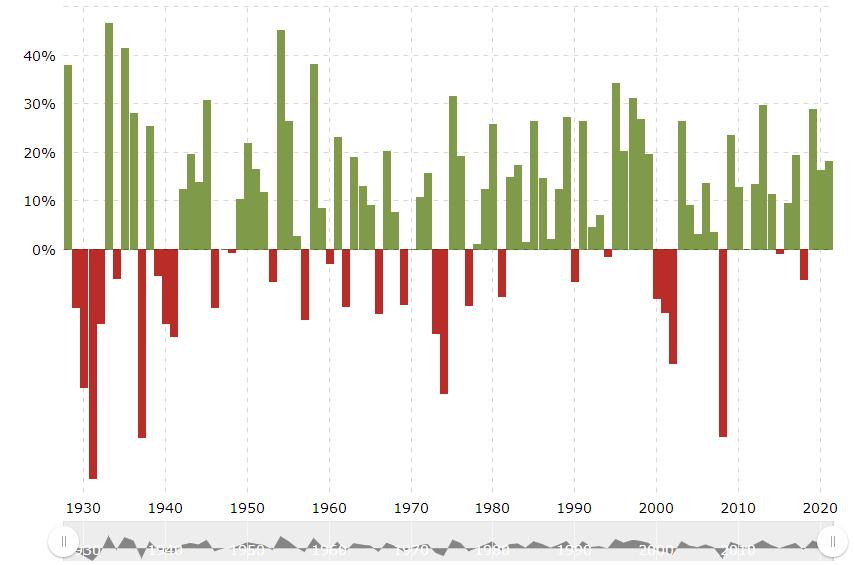
In spite of all the hype it has only increased 7.3% per year on average since 1957. Or 10.5% per year with dividends reinvested.
Slowing the returns of the SP-500 are several down years—as you can see above
And that includes the recent phenomenal gains of 21.95% through the first three quarters of 2021—the 18.4% return of 2020 and the whopping 31.49% increase from 2019.
By the way–history shows that the returns following outsized years tend to be low to negative—
So the data says that disappointing performance in the SP-500 could begin soon.
That’s an immediate problem but it’s not the real problem—the real problem is most people didn’t start investing long enough ago to build up a big enough account to retire on.
The truth is most people NEED to get huge returns going forward if they are ever going to be financially independent—and the big stocks of the SP-500 will NEVER be able to get them there in the time they have left.
Time is running out…
For one simple reason—it’s hard for a large company to double or triple its stock price.
And surprisingly that’s even true for the best of the big caps.
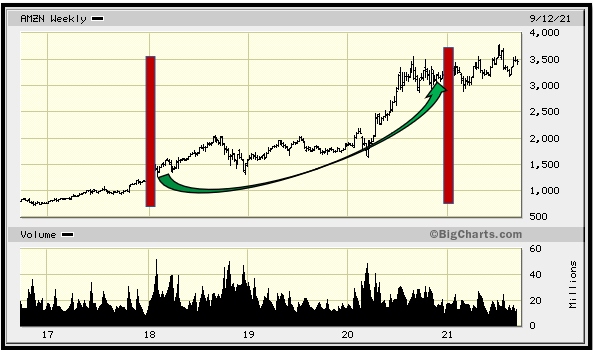
Take a company everyone widely acknowledges as a fast-growing household name that dominates its markets. The poster child for that kind of world dominator is Amazon (AMZN).
From the 3 years beginning in 2018 to the beginning of 2021 Amazon ran higher by an incredible 154%–which included a phenomenal price jump of 106% in just three months in early 2020.
Even catching a major stock’s run higher wouldn’t get you where you need to be.
That’s impressive and anyone would be proud to have held the stock during that period of time giving you bragging rights to your family and friends forever.
But is it enough? And can you do better?
The truth is for most of us—if you want to become financially independent with any degree of comfort—you are going to need to do better.
And that can be a tall order in the regular stock world.
If you are heavily diversified with the SP-500 the best you can hope for is 10 to 11% per year over time. That’s what the hard data tells us. And the same data says the next few years might massively underperform even those modest figures.
But even picking the very best of the big caps with a stock as phenomenal as Amazon you’re still looking at maybe a double or a triple. That’s the best you are ever going to get on a large well-known company.
But smaller companies double or triple their stock prices all the time—in fact some can go up ten times in as little as 3 years!
That’s a whopping 1000%.
Here’s a fact the financial advisors never tell you—the small cap index as represented by the Russel 2000 has outperformed the SP-500 over time—and sometimes has outperformed it by extremes.
For example, in the period between 1979 and 1983 the Russell 2000 outperformed the S&P 500 by an astounding 80% during a period of extreme economic turbulence in the stock market—like the kind we might be coming into.
Investors judged that smaller companies navigated the environment more nimbly than larger ones—and invested accordingly.
Then again from 1990 to 1994 during the 1990-91 recession and its immediate aftermath, small caps again outperformed the S&P 500 by nearly 50%.
And then more recently from 1999 to 2014 a new era of turbulence began with the tech wreck, 9/11, Afghanistan and Iraq wars, the subprime bubble, the economic meltdown and quantitative easing—during these volatile years small caps outperformed large caps once again, with the Russell 2000 thrashing the S&P 500 by 114%
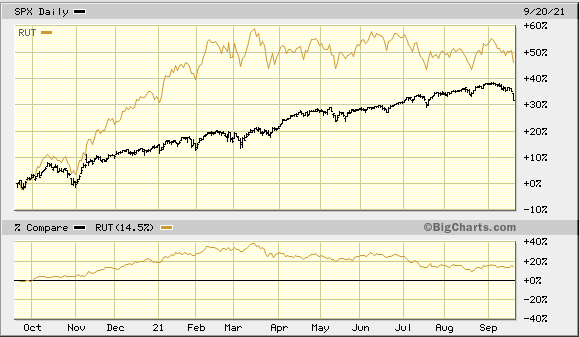
The Russell 2000 massively outperformed the SP-500 from November 2020 to September 2021—and will likely continue to.
Who would have ever thought that investing in small caps could be an effective safety net in an economic meltdown?
But history shows they are—and they probably will be again the next time the SP-500 crashes.
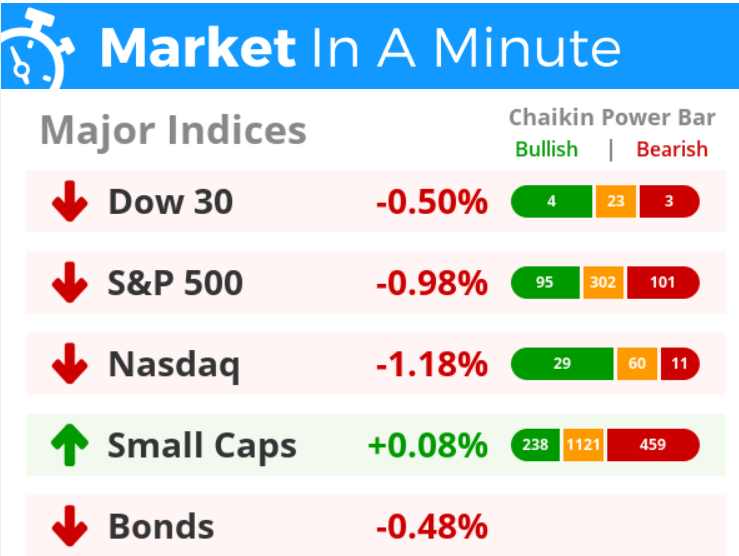
This is a snapshot of the market on the morning of September 20, 2021 when the SP-500 plunged 72 points at the opening bell.
But it gets even better for extreme small caps—the kind known as ‘microcaps’ especially when they are growing fast with a real technological edge.
If it was just me making this money it wouldn’t mean much to you—but it’s not—a ton of happy subscribers have come along for the ride.
Here's What People are Saying
“We are heading to Hawaii next week for seven days. To some degree, compliments of you! Could I have afforded a trip like this before? Yes. But now I can afford it carefree, without worry, that’s a big difference.”
– Billy Mitchell
“Hi Peter,
All I can say is thank God and thank you for sharing your knowledge and expertise!
You are literally an answer to my prayers.
The trust account I manage was being rapidly depleted due to the 24/7 care that my mom needs. But now, with your help, I’m seeing enough cashflow to cover 90% of that monthly bill!
As for ABML, I picked up 10,000 shares for .03…you can imagine my excitement that my wife and I are debt-free from just one trade.
God bless you, and I hope to meet you one day to thank you in person.”
– Russ
“ABML brought in about 30K for the month of December which contributed to a very Merry Xmas. Fear not, I’m still in ABML long term and I thank your entire staff. Cheers!”
– Robert Yalden